
Once, someone saw me and said:
“You look really tired today.”
People always seem to blurt out comments like this quite naturally, as if they’re sharing some incredibly important new information with you.
Thankfully, she told me.
Otherwise, I might have kept thinking that the dark circles under my eyes were some kind of trendy facial accessory.
I was indeed very tired back then.
I was working late, getting poor-quality sleep, and constantly pretending that drinking one more cup of coffee was enough to take care of myself.
My face was simply honestly revealing the state of my life.
But that comment still bothered me.
When I got home that night, I stood in front of the mirror, carefully inspecting every fine line, every dark spot, and every uneven patch, as if my face had just committed an unforgivable mistake.
I started pulling out concealer, foundation, highlighter, blush, mascara, and all sorts of products with names like “correct,” “invisible,” “perfect,” and “erase.”
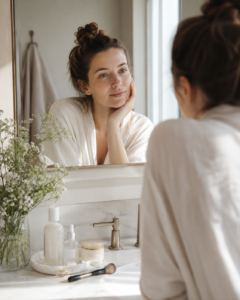
But what exactly was I trying to erase?
Was I trying to erase the evidence that this past week had actually happened?
I love putting on makeup.
I love the process of applying it, the transformations colors bring, and that sudden burst of energy I feel when I find a lipstick that’s just right for me.
Makeup can be fun, sexy, therapeutic, or even daring.
But at some point, I stopped using makeup to express myself and started using it to apologize to others.
It’s as if my natural self needs to be explained and altered before I’m fit to go out in public.
Once I realized this, I changed the way I apply makeup.
I didn’t throw away all my makeup, nor did I declare that every woman must go bare-faced.
That’s completely unnecessary.
Some mornings, a little mascara and blush lift my spirits far more effectively than ten inspirational quotes.
I’ve simply reframed the question.
I used to ask:
“How can I cover up all these imperfections?”
Now I ask:
“What can I do today to make myself feel a little more comfortable?”
Sometimes, the answer is tinted moisturizer, cream blush, a quick eyebrow touch-up, and a swipe of lip balm.
Sometimes, the answer is putting on a bright red lipstick at 10 a.m.—and I don’t need a reason at all.
And sometimes, the answer is going makeup-free, wearing a baseball cap, and avoiding unnecessary eye contact with anyone at the supermarket.
Beauty should allow for these choices to coexist.

I’ve also started paying attention to the language I use when I look in the mirror.
I’ll say my skin looks terrible.
My eyes look old.
My face is too puffy.
But if a friend were standing next to me, I would never say those things about her.
So why is it so natural for me to speak to myself this way?
Our faces are meant to change.
They’re influenced by sleep, stress, emotions, the weather, hormones, age, smiles, and tears.
They’re even affected by a dinner that was too salty the night before.
A face isn’t an object that stays the same forever.
It’s a living record that’s constantly being written.
This doesn’t mean we can’t take care of our skin, wear makeup, or get beauty treatments.
Caring about your appearance isn’t shallow.
Wanting to look fresh and beautiful isn’t a desire that deserves criticism.
But taking care of my face and constantly criticizing it are two completely different things.
Now, when I look tired, I try to respond in ways that are more helpful than blaming myself.
Maybe I need to drink some water.
Maybe I need to get some sleep.
Maybe I should put my phone down.
Maybe I just need a little concealer—and a dash of humor.
I still want to look fresh and vibrant.
But I no longer believe that looking tired means I’m not pretty enough, not professional enough, or not worthy of being seen by others.
Some days, your glow comes from highlighter.
Other days, your glow comes from finally letting yourself off the hook.
Both count.